
This studio will explore a range of design trends and themes, including detailed research into colour and material trends in India.

Sale of iPhones hits the bottom; firms to postpone new launches; shipment might fall short of 2016 target.

From auto, refrigerator, and mobile handset makers to real estate firms, companies are tying up with banks to dole out attractive finance schemes and discounts to make buying more affordable.
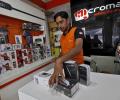
At least two of them - Lava and Micromax - are arming themselves against the Chinese rivals which made them insignificant in the local market over the past few years.

Artificially intelligent smartphones will be able to offer solutions and suggestions based on user behaviour.
Taiwanese mobile handset company BenQ said on Thursday it is still keeping the option of setting up a manufacturing unit in India open, although it has suspended the project for the time being.
New mobile subscriptions in India are likely to surge 50 per cent in 2007 from the previous year, mainly driven by growth in the ultra low cost market, global equity research firm Citigroup forecasts.
Apple, Research In Motion and ZTE Corp joined the ranks of the world's 10 largest mobile phone makers in 2007, underlining how technology advances and emerging markets are producing a new cast of winners and losers in the industry.
The actual number of people using mobile phones is 2.5 billion, as about a quarter of users are thought to have 2 or 3 mobile-phone connections.

Two full-fledged semiconductor fabrication plants are going to come up in India very soon entailing multi-billion dollar investment besides several chip assembly and packaging units, Minister of Electronics and IT Rajeev Chandrasekhar said. In an interview with PTI, the minister confirmed that the two projects include a $8 billion proposal submitted by Israel-based Tower Semiconductors and the other from Tata Group. "I am happy to share this with you and you are probably the first one I'm sharing this with.

The government's stated vision is that it wants to make India a manufacturing hub and that is where such a rush or confusing policies don't help, reports Shubhomoy Sikdar.

The California-based firm reported a healthy growth of 5 per cent in its monthly active users in India to 82 million as of June 30, 2013 from 78 million in June 30, 2012.

On the flipside, since 60-70 per cent of the costs pertain to raw material, which are mostly imported, currency fluctuation is a key risk for the segment.
According to Swedish researchers, who carried out a study, long-term users have double the chance of getting a malignant tumour on the side of the brain where they hold the handset, the Daily Mail reported in London on Monday. An hour a day on a mobile phone for over ten years, is be enough to increase the risk.

The network protocol being built by Umesh Chandra of the Nokia Research Center in Palo Alto, California, will also get mobile phones connected to the web via SMS.

Nokia is hiring software experts, testing new products and seeking sales partners.

Handset firms Karbonn and Lava International launched their smartphones, while Maxx Mobiles introduced its feature phone targetted at the rural market.

Bharti Global, the international investment arm of Bharti Enterprises, has decided to buy 24.5 per cent equity in BT Group - a move that will make the Indian conglomerate the biggest shareholder in the UK's second-largest telecom company both in terms of market value and subscriber count. The shares are being purchased from billionaire Patrick Drahi's Altice UK through a combination of cash and debt .

The chipset accounts for over 25%-30% of the cost of an average smart phone. Hence, a reduction in its price, device makers say, will make a huge difference to the cost of a phone.

Even though PUBG Corporation is a South Korean company with its headquarters in Seoul, Tencent Gaming, a subsidiary of Chinese investment and technology giant Tencent, holds the global franchise for the mobile version of the game.

Though leading brands like Samsung, Apple, Xiaomi, OnePlus, and Oppo managed to absorb the initial lockdown shock and resumed their local production back to 60 per cent, they would likely suffer a 20-25 per cent loss of sales in the October-December quarter.

India to become second largest smartphone market by 2016.
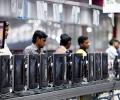
It was expected that supplies from China will be back to normal by end-June as their factories are now operating at nearly 90 per cent of normal capacity. But the recent issue with shipments has placed an obstacle that manufacturers can't bypass.

Even as worldwide smartphone sales touched 115 million units in the third quarter, a rise of 42 per cent compared to the year-ago period, the growth in sales dropped to seven per cent compared to the second quarter, says research firm Gartner.

In 2015, as many as 15 major Chinese smartphone brands stepped into India.

From the rollback of customs duty on key electronic components to fast tracking delivery of goods imported from China, players are looking for incentives on several counts.

The number of new entrants is decreasing since 2015, as Indian market matures

Korean electronics major Samsung expects its new foldable devices Galaxy Fold 5 and Galaxy Flip 5 will enable it to capture half of the super premium smartphone segment in India, currently dominated by iPhone maker Apple.

To promote localisation of manufacturing and reduce its import bill, the government increased basic customs duty on mobile handsets - from 10 per cent to 15 per cent.
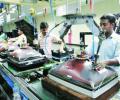
'The government expects demand for electronic products to reach $400 billion by 2023-24. This would be a huge foreign exchange outflow, which may further widen our trade deficit with other nations. Hence, the government plans to push local electronics manufacturing to cut down on their import bill.'
It has 18.9 per cent share of the market, down from 22.6 per cent for the third quarter of 2018 while Xiaomi has 27.1 per cent share.

Samsung is lining up new products, increasing focus on e-commerce channels and tightening its grip over retail outlets.

Budget smartphones will rule the market in 2015.

Images from the Bhanga Mela, India's only e-waste market.

The once-popular brand plans to try its luck in the smartphone market with reliability as its key proposition.

With India rolling out 5G services, can telcos get the sizeable 350-400 million 2G customers to upgrade to 4G, or even better -- but very improbably -- straight to 5G?

Whoever can make acquiring smartphones more affordable will win the sales game.

Apple Pay also faces competition from Merchant Customer Exchange (MCX) - a consortium of retailers including Wal-Mart and Best Buy - which is developing its own mobile payment platform.

Indian telcos have been able to garner over 20 million 5G customers in less than four months after the official launch of the service last October, according to industry estimates. With telecom operators like Reliance Jio and Bharti Airtel aggressively rolling out their 5G services in over 190 cities across the country to date, India is now only behind China and the US in terms of the number of cities in a country where 5G services have been extended. Top executives in telcos say that the number of 5G subscribers in India is a conservative estimate and that it will rise as the roll-out gains momentum.
